Posts

Simulations Games Social and Trends

I received some interesting questions (and you know I love questions) from someone doing eLearning industry market research around trends in simulations, games, social learning.  They said they would be fine with me posting my thoughts.  I’m sure they’d love to get thoughts from others as there’s likely not enough data around this stuff to be super comfortable making business decisions. Question 1 - As the notion of “learning as an event” begins to be replaced with true “just-in-time” learning, (in the form of learning communities and availability to portals of knowledge and information) do you think off-the-shelf eLearning programs in professional skill development will continue to be one component of a learning solution? Will they grow in need, become obsolete, or remain the same? This is a case where I look back at what I’ve written: Course and Courseware Fading - The Future of eLearning Shift in Blended Learning - Example of Melding of Training and Support...
eLearning Innovation 2010 – Top 30

I had an interesting conversation the other day about whether there’s that much new going on in eLearning here in 2010.  The general sentiment around the room was that many workplace learning organizations were focused on nuts-and-bolts training, and that there was little innovation. I’m probably not the best judge of whether there’s innovation going on because: People call me when they want to do something innovative.  I tend to work on things that are a bit leading edge like Data Driven performance solutions or eLearning Startups or the next great idea that someone has. In the world of eLearning, I generally pay attention to other innovators.  These are often bloggers as exemplified by the great bloggers found via eLearning Learning .  I also might be talking to people I’m talking to in conversations who are thinking about something innovative. So, I’m afraid that I’ve a skewed perspective. That said – I’m still under the impression that my centra...

Social Learning Tools Should Not be Separate from Enterprise 2.0

Image
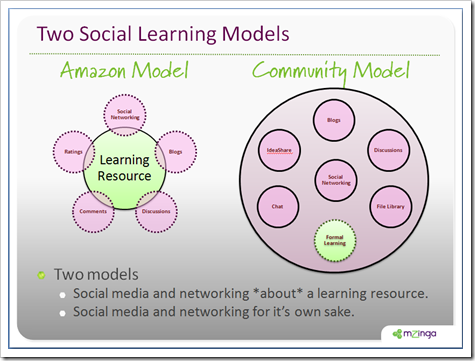
With the recent launch of InGenius by SkillSoft, I believe it’s time again to raise a pretty important question: Where do Social Learning Tools belong?  Should they be coupled with your LMS or other learning-specific tools?  Or should they be separated?  Or ???? My contention (as expressed in LMS and Social Learning ) is that most of the vendors are getting this wrong.  Instead of looking at providing tightly coupled Social Learning Tools, they should instead be looking at how their offering can integrate or leverage Enterprise 2.0 tools.  Using David Wilkins diagram: We are talking about how formal (or informal) can leverage tools that employees will be using outside of the context of learning.  This could be: SharePoint, Yammer, Confluence, etc. John Ambrose in Social Learning Will Fill Enterprise 2.0’s Empty Drums discussed part of the strategy with InGenius.  It’s finding content that can fill the empty drums of enterprise 2.0 tools ...

Failure of Creative Commons Licenses

As part of last month’s big question Open Content in Workplace Learning? , I’ve been trying to find out more about specific answers to Creative Commons Use in For-Profit Company eLearning .  I was contacted by someone out of the Creative Commons organization, but in going back and forth with them, we realized that I was looking for legal interpretations which they clearly can’t do.  They are there to help set up the licenses.  But that said, it also shows a failure of the current licenses. What do I mean by a failure? As I pointed out in my previous post, Creative Commons themselves conducted a study to understand commonly held interpretation of the understanding of the meaning of these licenses.  This common interpretation is important if you are going to defend your use of licensed materials.  But it also shows that lots of interpretation is required. The person from Creative Commons suggested I post to the cc-community mailing list my questions.  ...

Social Media for Knowledge Workers

Last week I had a presentation around using Social Media and Web 2.0 tools to improve your performance as a knowledge worker.  One of the questions that always comes up is: How do I find more information to help me get started? The answer is that this information is a bit hard to come by.  There’s a lot out there, but it’s often hard to find information that helps you get start.  This was a major reason that I started down the path with Work Literacy .  That said, I thought it would be worthwhile for me to collect a few of the resources that provide good starting points that can help Knowledge Workers improve their performance using Social Media. Overview of Knowledge Work and Social Media Tool Set 2009 Work Skills Keeping Up Top-Down Strategy Knowledge Work Framework Sense-making with PKM Keeping Track of Information Better Memory Keep track of information Handling the Flow of New Information Information Radar ...

Twitter for Learning – 55 Great Articles

In a recent conversation, I was asked what I thought about twitter as a learning tool. Over the course of the past few years I’ve moved from saying “I don’t get it” – to feeling like it’s a good addition to my Learning Tool Set . But I also think that there’s a lot more help now around how to make effective use of Twitter as a learning tool. I thought it would be worthwhile to pull together these resources. Twitter and Teaching Twitter Tips: for Teachers & Educators - Don't Waste Your Time , May 9, 2009 Twitter in the classroom: 10 useful resources - Social Media in Learning , August 12, 2009 Presentation: Twitter in Education - Don't Waste Your Time , May 12, 2009 Adding Facebook and Twitter to student participation - Don't Waste Your Time , November 4, 2009 Twitter in your Teaching - eLearning Acupuncture , September 24, 2009 Twitter - A Teaching and Learning Tool How to use Twitter for Social Learning , March 20, 2010 Teaching with ...

Creative Commons Use in For-Profit Company eLearning?

As part of the Big Question this month Open Content in Workplace Learning? , I’m exploring whether Open Content can be used by for-profit companies.  And, since Open Content comes in under the Creative Commons license structure.  Actually, I’m curious if Open Content ever is not Creative Commons?  It’s by definition Open, but theoretically you could choose a different open license. I’ve just never seen it. In any case, to understand the use of Open Content, it’s important to understand Creative Commons licensing. Creative Commons Licensing Terms Creative Commons licensing terms.  All CC licenses start with: Attribution   (CC-BY) – Allows others to copy, distribute, display and perform a copyrighted work – and derivative works based upon it – but only if they give credit. All CC licenses contain this condition. Licenses may have one or more of the following permissions or restrictions: Non-Commercial (NC) - Allows copy, distribute, di...